
He even got to take a photo of friend, Cecil B. De Mille.
In addition, as a teen-ager, he enhanced stars' photographs with oil paint for display in theater lobbies. The experience stuck with him, and years later stars praised his ability to retouch their images.
Also, while still in his teens Allan opened a photographic concession in a dime store on Hollywood Boulevard, where he photographed many actors and aspiring movie stars. These pictures led to employment as a photographer for several large film studios including MGM. Allan took over Hurrell's gallery at MGM, where his nickname was ‘Rembrandt’ - and stayed for four years until 1937. Allan replaced Hurrell in 1933 after photos from TARZAN AND HIS MATE, especially those of his mate, Jane (Maureen O’Sullivan) were seen by the Tarzan producer.
In his time at MGM he has said: "Later on, when I worked elsewhere, though I made more money I never felt as secure as I had at Metro." And of his image work at MGM he said: "Because the 8 x 10 negative was so necessary to the inexpensive mass printing needed by the studios, there was no such thing as custom enlargements or recomposing. It was essential to compose directly onto the negative. The weightless camera and the ball-and-socket head (built especially for me by the MGM engineering department) allowed me to view the posing, lighting, and compostiton on the ground glass as I moved and adjusted the camera to sit the subject. To create dimenson, it was necessary to control the planes of illumination. The conventional method then was to shoot with a high-key single-source floodlight or soft skylight illumination. The MGM studio engineering department built a set of portable boom lights for me. I used them for back and side line-lights and found it helpful to swing a free-wheeling boom light across a face to find the most interesting angle of light for the subject. In my portraits I have a small area of pure white that allows the skin tones to be printed darker and with definition."
During those years he was Harlow's primary portrait photographer. He said of Harlow that "When I first auditioned for the job of replacing Hurrell as exclusive photographer for Jean Harlow--Russell Ball and Tom Evans were also trying out--the first requisite was that I present her as more of a lady. I insisted that her hair be toned down into what Jack Dawn (head of MGM's makeup and hairdressing department) termed brownette.
Of all the people I thought wouldn't feel self-conscious when posing--after all, the whole basis of her personality on the screen was outgoing and freewheeling--it was Jean. Yet when it was time for the stills, she was--terribly shy. When she arrived I already had everything set up in the four corners of the room, so that I could go zing-zing-zing, because she'd change so fast. While she did that, I'd change the four spots and set up a new series. It was very rapid, and she loved that. One of these photographs was a sort of 'end of the pier' scene, with fishnets hanging down. She went over and threw a fishnet over her shoulders and then suggested that it would show up better if there was bare skin beneath it, since the net was the same color as the knit suit she was wearing. I went back to the camera to adjust things, and when I looked up she was walking around with this thing wrapped around her and nothing underneath. I thought 'Wow,' and tried to stand between her and her hairdresser, who might come through the door any minute. But it didn't bother her at all. It was more as if she were playing a part, calculated to get me on her side. She figured that if I were turned on, I'd take better pictures. And she'd go on during the sitting as long as I would. Her limousine would be out there waiting all day. After she'd had a couple of drinks, she'd get into the mood and begin to enjoy posing. Then she'd go like wildfire. I realized then that she always needed something personal--the feeling of being liked. It make her feel secure."
Allan also had a particularly good rapport with male stars. Unlike Hurrell and Bull, whose reputations rest with women, Allan brought an appealing masculinity to subjects as diverse as Robert Taylor, James Stewart and the wacky Marx Brothers.
(Laszlo Willinger became Ted Allan's successor at MGM.)
Allan's photography was so popular that when he worked as a still photographer with Mae West when she starred in "Belle of the Nineties" his portraits of Ruby Carter (West), and her gaudy retinue, were used on lobby cards and other promotional material for Paramount Pictures. But mostly, from his career (around 1934 to 1965) he was often an uncredited still photographer on several films.
Allan quickly moved behind the still camera when he established his own portrait studio in Hollywood in 1933. Over the years he photographed such stars as Clark Gable, Carole Lombard, James Stewart, Spencer Tracy, Shirley Temple, Helen Hayes, and John, Ethel and Lionel Barrymore.
However likeable Allan was, there was one particular star who made it hard to shoot her and that was difficult actress Norma Shearer. She was very particular about her portrait photographers as she was about her cameramen. Allan photographed her in 1935 when she was playing Juliet to Leslie Howard's Romeo. "I was concerned about Miss Shearer's very close-set eyes. An improvised gallery was set up in the center of a bare stage. The circumstance, with its lack of intimacy, was as cold as the star's attitude. Miss Shearer had arranged for a large full-length mirror, I certainly wasn't getting it in my camera, which was several feet to the side. She was concentrating on her mirrored image, and I made the mistake of saying, 'I'm over here, Miss Shearer.' The sitting ground to a halt. During lunch I audaciously scraped an area of silver off the mirror and finished the sitting through the mirror. After that I never heard from her again."
A good deal of a photographer's success, then, depended, in Allan's words, on "getting them (the stars) to relax and enjoy themselves. They could cross you up completely by being stilted and uncomfortable."
After MGM, he worked for several studios including Fox until he opened the Ted Allan Film Studio in 1952 and worked mainly on shooting documentaries and low budget feature films. Ted Allan’s Studio was infamous for giving Ed Wood his magnum opus with Bela Lugosi BRIDE OF THE MONSTER, which Tim Burton immortalized in ED WOOD.
But he never left photography behind and shot photos for many of Frank Sinatra’s films and was one of the first to go into television, shooting stills for CBS Productions for a number of years. While working for CBS Radio, he got to work with De Mille again on De Mille's 'Lux Radio Theatre'. He later worked for ABC television and several film productions, including "The Sand Pebbles" and "Von Ryan's Express."
Allan, according to a catalogue entry during a 1987 show at the Los Angeles County Museum of Art, "adhered to the portrait photographer's mandate, to make mere men and women into objects of fantasy . . . with poses and dramatic lighting . . . and retouching."
His work has also been exhibited at the New York Museum of Modern Art, the National Gallery of Art in Washington, and in London and Venice, Italy.
It was Frank Sinatra who placed Ted in the limelight for all time. Frank made Ted his personal photographer, and Ted went on all of "Old Blue Eyes’" films. By then Frank had given Ted his own "Rat Pack" nickname of ‘Farley Focus.’ Ted Allan was dazzled, referring to all this as "the best time a man could have in this life."
(The veteran photographer was under personal contract to Sinatra for nine years in the 1960s and 1970s, taking pictures of the singer at recording sessions, during film productions and on world tours.)
David Del Valle who knew him said:
I knew Ted and his wife Jeanne so well they became my second family as did Laszlo (Willinger) and his wife Yvonne. (She had been a Music Hall favorite in her youth and helped introduce a very young Julie Andrews to English audiences.) Jeanne Allan used to love to tell me how Carman Miranda kept her cocaine in the heels of her shoes for that emergency when the “South American Bombshell” might need a special lift!! These two couples were close friends as John (Kobal) kept them all very busy with exhibits and a very lucrative endeavor known as “portfolios’” of their respective photography.
Ted Allan was the most likeable as he wanted everyone to like him. Ted just needed to have some time away from his wife and daughter since they all lived together in a jungle-like abode below the Hollywood sign in exile and frustration, having lived in an era once filled with travel and glamour, longing for the lost style of better days.
Ted Allan got his wish and is remembered as one of the best-liked studio photographers. He also had a reputation as a master printer and printed extensively from his and other photographers’ negatives for John Kobal’s exhibitions and was respected for his superb darkroom technique.
He died December 20, 1993 in Los Angeles, California. Allan, who lived in the Hollywood Hills home he built in 1929, died on a Monday at St. Joseph Medical Center in Burbank after a long illness.
Allan was survived by his wife of 64 years, Jeanne, a daughter, Holly Allan-Young, a granddaughter and two great-grandchildren.
The family has asked that any memorial donations be made to the Motion Picture and Television Fund in Woodland Hills.
Special thanks to: The Los Angeles Times, The books Glamour of the Gods and The Art of the Great Hollywood Portrait Photographers 1925-1940, The National Portrait Gallery and David De Valle for their help with the research for this article.

Tarzan and his Mate, Johnny Weismuller and Mareen O'Hara

Many of Allan's work was used in Lobby cards like the one of Mae West here.

Jean Harlow with and without Clark Gable.


With Cary Grant


Barbara Stanwyck

Eleanor Powell--"She liked my pictures so much that she proposed marriage," he told The Times. "I said, 'That's all well and good, but I don't think my wife would understand.' " Below Allan with Powell:


Allan said of James Stewart: "Two years after Stewart had been with the studio, we still didn't know what to do with him. Was he a comedian, or a romantic leading man? We tried photographing him outside, leaning over fences, working with a shovel, with a tennis racket--but while that worked with Robert Taylor in helping to make him more athletic, it didn't work with Stewart. There was no problem in making him look handsome--he had great eyes and a generous mouth, but in the time I worked with him, I wouldn't have guessed he'd become a star."

Look closely and on certain photos you can see Allan's signature to the bottom right hand side. One of his early trademarks.


James Stewart

Lionel Barrymoore

Madeleine Carroll.

The Marx Brothers

Robert Taylor

Shirley Temple

Spencer Tracy

Carole Lombard--"Carole Lombard was a favorite of mine," Allan told The Times in 1987. "She was real down to earth. She was the first movie star I ever heard use a four-letter word."
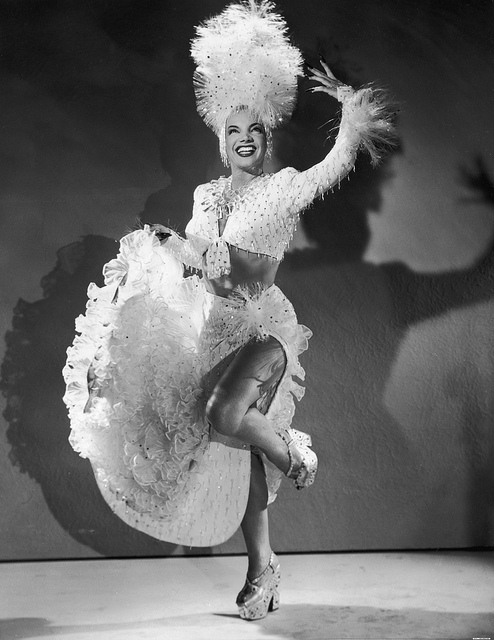
Carmen Miranda

Dean Martin

Orson Welles

Myrna Loy

Frank Sinatra and below with Mia Farrow.

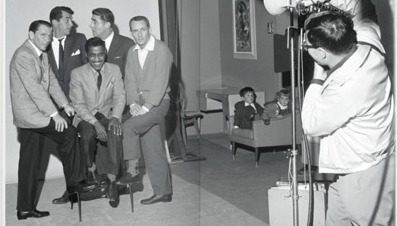
Ted Allan photographing "The Rat Pack."

Ted on the set with the Rat Pack.

Ted in back on the set of "Four for Texas."

He did many photos for "The Thin Man" series. He took the photo above.

Notice Marilyn Monroe in these photos taken by Allan.


Steve McQueen

Allan with McQueen.

John Barrymoore
Later in the 60s he took these photos on a contact sheet of Raquel Welch:


Ted Allan young and older.

His Stamp.


